The extraordinary life of Barney A. Ebsworth: the boy from St. Louis who played cricket, earned Eagle Scout alongside his father, ran the quarter-mile, built cruise lines, assembled one of the greatest American art collections in history, lived next door to Bill Gates, and counted presidents among his closest friends.
"My eyes were my mentors."
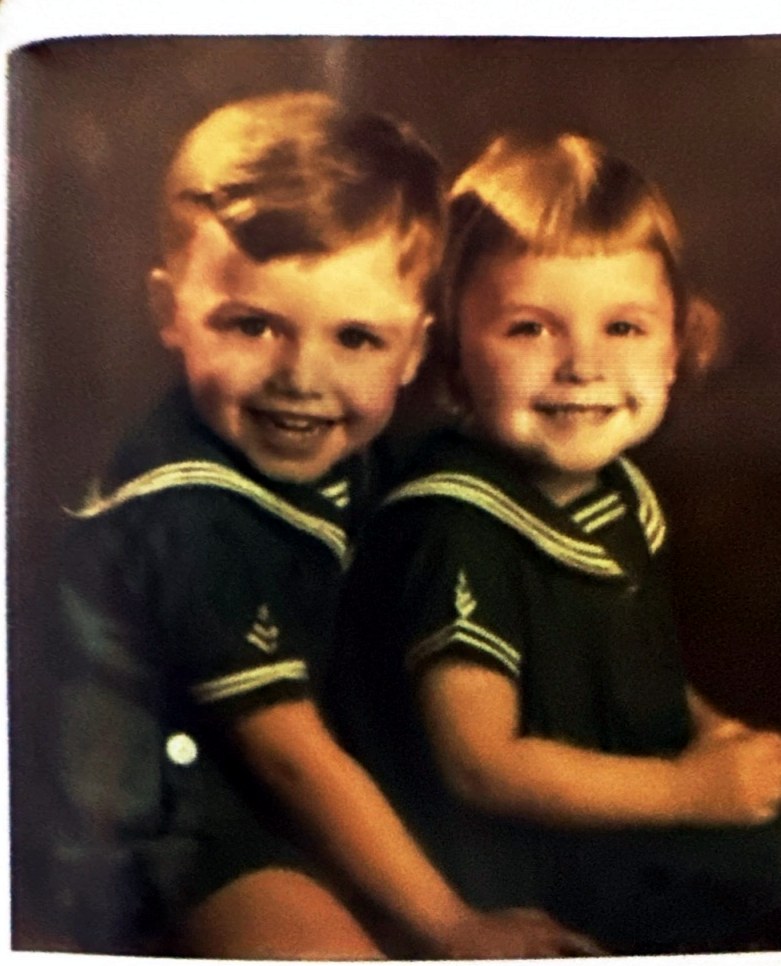
— Barney Ebsworth, on teaching himself art history at the LouvreBernard Alec "Barney" Ebsworth was born alongside his twin sister Muriel on July 14, 1934, in St. Louis, Missouri. His father, Alec Ebsworth, was British — Alec had grown up at Buckingham Palace, where his grandfather was commander of the Grenadier Guards. His mother, Bernice Gapen Ebsworth, was American — one of the Gapen sisters whose other sister, Lillian, had married into the Frauenthal family, connecting Barney by blood to a lineage that included Civil War heroes, Titanic survivors, and the father of an entire Arkansas town.
Despite the grand British pedigree, the Ebsworth family in St. Louis was modest. Barney described their circumstances plainly: they lived on "one and a half paychecks." But the household was anything but ordinary. Young Barney grew up playing cricket — very unusual for an American boy in 1940s St. Louis — a remnant of Alec's English upbringing. The boy absorbed two cultures: the stiff-upper-lip discipline of his father's world and the scrappy, self-made American ambition of his mother's family.
The Gapen sisters are the crucial dot that connects this story to a much larger American saga. Bernice Gapen married the Englishman Alec Ebsworth and produced Barney. Her sister Lillian Gapen married into the Frauenthal family, connecting to Max Frauenthal — the Confederate cavalryman who founded Heber Springs, Arkansas — and to Dr. Henry Frauenthal, who survived the sinking of the Titanic. Through the Gapen sisters, the boy playing cricket in St. Louis carried the DNA of soldiers, pioneers, and survivors.
Barney achieved the rank of Eagle Scout — at the same time as his father Alec, a father and son earning Scouting's highest honor together. He excelled as a track athlete at Cleveland High School in St. Louis, where he was a standout quarter-miler. The speed and discipline of the track would define his approach to everything that followed: business, art, life.
Ten years older than his cousin Paul Terry Walhus, Barney became a mentor to the younger boy. Paul, running at Bayless High in Affton, was also a gifted quarter-miler — finishing second in his conference, behind only Wayne Hermann of Clayton High. The two cousins were close friends growing up in St. Louis, and Barney — the older, more experienced runner — pushed Paul to be faster, tougher, and more disciplined on the track. It was a bond forged in shared sweat and competitive fire that would last a lifetime.
Barney's speed earned him an athletic scholarship as a sprinter to the University of Missouri, and he later transferred on an academic scholarship to Washington University in St. Louis as a business major. But it was the U.S. Army that changed everything.
Stationed in France during the 1950s, Barney spent his weekends at the Louvre, teaching himself art history by simply looking. No professors, no textbooks, no curriculum. Just a young soldier from St. Louis standing before Delacroix, Monet, and Cézanne, training his eye to see what made great art great.
"In real estate, they say three things matter: location, location, location. For me, collecting art was about quality, quality, quality."
— Barney EbsworthOn New Year's Eve 1956, at a USO party in France, Barney began dancing with Martine de Visme, a 19-year-old French girl, at the stroke of midnight. They married in March 1958 in France. He brought his bride home to St. Louis, where they had their only child, Christiane.
The romantic impulse that seized him at midnight in a foreign country was the same one that drove everything else: see something beautiful, pursue it completely, hold nothing back.
Upon returning to the U.S., Barney channeled his energy into the travel industry. He wasn't just a businessman; he was a pioneer of the "luxury experience." At age 25, he founded INTRAV in St. Louis in 1959 — and then kept building.
International Travel. Luxury group tours and chartered experiences. Pioneered the first American charter tour to the Far East (1967) and the first "Around the World by Private Concorde" (1987). Eventually sold to Swiss travel giant Kuoni for $115 million.
Barney didn't just sell luxury travel — he built the ships. Royal Cruise Line brought the Ebsworth standard of quality to the open ocean. An entire fleet bearing his vision of what travel could be.
Small-ship cruising for the discerning traveler. While the industry chased bigger and bigger vessels, Barney went the other direction: intimate ships, extraordinary destinations, curated experiences.
Through his firm Windsor, Inc., Barney and partner Wayne Smith invested $4.5 million for a 20% stake in Maxine Clark's startup. It became a global phenomenon — a billion-dollar brand built on the simple joy of making something with your own hands.
The throughline is unmistakable: Barney Ebsworth built experiences. INTRAV sold the experience of seeing the world. Royal Cruise Line sold the experience of living on the ocean. Build-A-Bear sold the experience of creation. And his art collection — the great work of his life — was the experience of seeing America through the eyes of its greatest painters.
Barney made a brilliant strategic decision that separated him from every other collector of his generation. He recognized that his millionaire's budget couldn't compete with the billionaires — the Gettys, the Broads, the Lauders — who were vacuuming up European masterworks. Instead, he would focus exclusively on American Modernism and build not the biggest collection, but the best. He would own the single finest example of each artist's work, and nothing less.
It was the same instinct his great-uncle Max Frauenthal showed when he put his store on the alley where the wagons parked instead of on the town square: go where others aren't looking, and be the best there.
The crown jewel. Two women at a table in a Chinese restaurant, bathed in pale winter light. It is considered one of the greatest American paintings of the 20th century. On November 13, 2018, at Christie's in New York, it sold for $91,875,000 — a record for any pre-war American artwork and the most expensive Hopper ever sold.
Under the title "An American Place: The Barney A. Ebsworth Collection", the two-day sale brought $323.1 million, set 13 artist auction records, and was the first auction recorded using blockchain technology.
| Artist | Work | Price | Note |
|---|---|---|---|
| Edward Hopper | Chop Suey (1929) | $91,875,000 | Artist record |
| Willem de Kooning | Woman as Landscape | $68,937,500 | Artist record |
| Edward Hopper | Blackwell's Island | $21,175,000 | |
| Georgia O'Keeffe | Lake George with Crows | $11,295,000 | Artist record |
| Marsden Hartley | Pre-War Pageant | $6,311,000 | Artist record |
| Plus works by Pollock, Johns, Warhol, Rauschenberg, Diebenkorn, Calder, Gorky, and 40+ more artists | $323.1M total | ||
The artists in the collection read like a roll call of American genius: George Ault, Peter Blume, Alexander Calder, Stuart Davis, Charles Demuth, Willem de Kooning, Arthur Dove, Arshile Gorky, Marsden Hartley, Edward Hopper, Jasper Johns, Franz Kline, Joan Mitchell, Robert Motherwell, Georgia O'Keeffe, Jackson Pollock, Robert Rauschenberg, Charles Sheeler, Andy Warhol, and dozens more.
In one of the most extraordinary acts of art patronage, Barney sold Warhol's Big Campbell's Soup Can in 2010 for $23.8 million specifically to finance the construction of a chapel designed by legendary Japanese architect Tadao Ando. The triangular design featured glassed-in walls cantilevered over a reflecting pool — a place of meditation and spiritual reflection for the Ebsworth Family, with an estimated cost of $10 to $20 million.
But community opposition blocked construction — first in Bellevue, then on Capitol Hill in Seattle, where residents dismissed it as a "vanity temple." The chapel was never built. Design models survive at the Art Institute of Chicago. It remains one of art history's great what-ifs: a man who traded one masterpiece to create another, but the world wouldn't let him.
Barney's connection to O'Keeffe went beyond collecting. When he married his second wife, Patricia Ann "Trish" Kloepfer, in approximately 1981, O'Keeffe herself served as the witness at their wedding, held at O'Keeffe's home in Abiquiu, New Mexico. When one of America's greatest artists stands witness at your wedding, you have entered a different sphere of American cultural life.
Barney's closest friend in St. Louis was William H.T. "Bucky" Bush — the youngest brother of President George H.W. Bush and uncle of President George W. Bush. The two men shared the same birthday: July 14 (Barney in 1934, Bucky in 1938). Bucky was a major St. Louis figure: a banker, co-founder of Bush-O'Donnell & Company, chairman of the board at St. Louis University, the Missouri Botanical Garden, and the Muny outdoor theater.
It was Bucky who brought Barney into the Episcopal Church in 1991. "George Bush's youngest brother, Bucky Bush, was a great friend of mine, and he took me to the Episcopal Church," Barney recalled in his 2017 Smithsonian oral history. Through Bucky, Barney was connected to the highest levels of American political power — a significant Republican donor, contributing to the RNC, the Romney Victory Fund, and the McCain campaign.
According to family accounts, a President Bush flew Air Force One to St. Louis to attend one of Barney's weddings — a testament to how close the Ebsworth and Bush families had become. In the rarefied social world of St. Louis's elite, the Ebsworth name carried the same weight as the Bushes, the Danforths, and the Busch brewing dynasty.
Bucky Bush died on February 27, 2018 — just six weeks before Barney himself passed away. The two friends, born on the same day, departed this world within weeks of each other.
In his later years, Barney moved to Seattle, where he commissioned architect Jim Olson of Olson Kundig to design a home at 4053 Hunts Point Road on the shores of Lake Washington. Completed in 2003–2004 at a cost of approximately $20 million, the 9,400-square-foot residence sat on 3.27 acres with 300 feet of waterfront and a 2,200-square-foot dock accommodating boats and seaplanes. The house was designed specifically around his art collection — Olson described it as "both about nature and about art, a backdrop for both."
His neighbors included Bill Gates and other tech billionaires in one of the wealthiest zip codes in America. But Barney's wealth was old-school: built on relationships, travel, taste, and decades of patient art collecting — not stock options.
After Barney's death, the estate was listed for $45 million and sold in April 2019 for $37.5 million — then a record for the most expensive home sale in the Seattle area. The buyer was later revealed to be Jeff Bezos. The house that Barney built to hold American masterpieces now belongs to the richest man in the world.
Barney's only child, Christiane, from his marriage to Martine, married Mark J. Ladd in Chicago. Together they built a stunning 10,400-square-foot home at 54 East Scott Street in Chicago's Gold Coast — the first LEED Gold certified single-family home in Illinois. It was listed in 2021 for $10.2 million and sold in 2023 for $6.5 million. Christiane served as sole executor of her father's estate and made the decision to auction the collection at Christie's.
Barney's twin sister chose a different path: she became a teacher. While Barney was building cruise lines and collecting masterpieces, Muriel shaped young minds in the classroom before moving from St. Louis to North Carolina, where she married Dave Mueller and raised four children, including Roger Mueller. The twins couldn't have been more different in their public profiles — one built a $323 million collection, the other shaped minds one student at a time — but they shared the same roots and the same drive.
The key to the entire story: Bernice Gapen married Alec Ebsworth and produced Barney. Her sister Lillian Gapen married into the Frauenthal family. Through the Gapen sisters, Paul Terry Walhus and Barney Ebsworth are cousins. The Frauenthal legacy — Max's courage at Spotsylvania, Henry's leap into the Titanic lifeboat, Barney W.'s Bureau of Information at Union Station — flows through the same bloodline as the Ebsworth art collection and the INTRAV empire.
The full family history: barneyfrauenthal.com
Martine de Visme (married 1958, met dancing at midnight on New Year's Eve in France). Patricia Ann "Trish" Kloepfer (married ~1981, with Georgia O'Keeffe as witness). Two subsequent marriages, the last to Rebecca Layman-Amato, who was by his side when he died.
Born July 14 in St. Louis with twin sister Muriel. Father Alec (British, Buckingham Palace roots). Mother Bernice Gapen (sister of Lillian, who married into the Frauenthal family).
Grows up playing cricket. Achieves Eagle Scout alongside his father. Runs the quarter-mile at Cleveland High School. Mentors younger cousin Paul Walhus.
Athletic scholarship to Mizzou, transfers to Wash U on academic scholarship. Serves in U.S. Army in France. Teaches himself art at the Louvre on weekends.
New Year's Eve: dances with Martine de Visme at midnight at a USO party in France.
Marries Martine. Brings her home to St. Louis. Their daughter Christiane is born.
Founds INTRAV at age 25. Begins building a luxury travel empire from St. Louis.
INTRAV grows. Begins collecting American art. Founds Royal Cruise Line (1972). The collector's eye sharpens with every acquisition.
Marries Patricia "Trish" Kloepfer. Georgia O'Keeffe serves as witness at O'Keeffe's home in Abiquiu, New Mexico. Founds Clipper Cruise Line.
INTRAV launches the first "Around the World by Private Concorde."
Bucky Bush brings Barney into the Episcopal Church.
Invests $4.5M in Build-A-Bear Workshop through Windsor, Inc. Sells INTRAV to Kuoni for $115 million.
Moves from St. Louis to Hunts Point, WA. Joins Bill Gates as a neighbor on Lake Washington.
Jim Olson designs the $20M Hunts Point estate around the art collection. 9,400 sq ft, 300 ft waterfront, seaplane dock.
Sells Warhol's Big Campbell's Soup Can for $23.8M to fund Tadao Ando chapel. Community opposition blocks construction.
Smithsonian Archives of American Art records Barney's oral history. His philosophy and life story preserved for future generations.
Best friend Bucky Bush dies. Six weeks later...
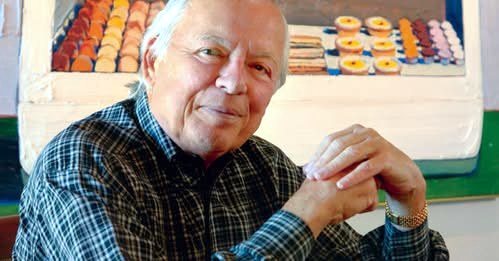
Barney A. Ebsworth dies at home in Hunts Point, WA. Age 83. Rebecca Layman-Amato and Christiane at his side.
Christie's auctions "An American Place: The Barney A. Ebsworth Collection." $323.1 million. Chop Suey: $91.9M. 13 artist records. Blockchain-recorded.
Hunts Point estate sells for $37.5M to Jeff Bezos. The house Barney built becomes Bezos's.
He started with one and a half paychecks and a father who taught him cricket. He ended with $400 million in art on the walls, a home that Jeff Bezos bought, presidents at his wedding, and a legacy that shattered records at Christie's. Between those two points is an American life so improbable, so layered with beauty and ambition and taste, that it reads like fiction.
But it happened. Every bit of it.
— From the research of Paul Terry Walhus, Barney's cousinExplore the Full Story